Cruisin' for a Bruisin'
The core of any fleet, cruisers like the Salem and Tacoma strike a perfect balance between tactical and strategic maneuverability, firepower, and survivability. They are the generalist core of the navy. They generally have long range, making them perfect for tending and leading groups of destroyers on their lonesome, or for acting as a heavy flanking force as a group. They generally have enough space and flexibility to mount flagship facilities, electronic warfare equipment, or additional crew bunks and recreation decks without sacrificing too much of their other attributes. They generally serve as the ambassadors when a message needs to be sent, but a battleship or fleet carrier is excessive and a destroyer lacks the prestige to serve in that position.
It's this generalization that gives rise to a number of variations of the basic idea of a cruiser. The Salem-class heavy cruisers, for example, mount the greatest concentration of electronic warfare and countermeasure equipment on any ship save for a dedicated EW platform.
A Salem's arrays of signal jammers and emissions maskers could prevent any one ship from reporting back before it's too late, all the while disguising herself as anything from a megafreighter to a flotilla of pleasure craft to a whole battle task group. This, combined with her main battery consisting of 18 8 TeV/203 MW 'superheavy' ultarelativistic electron beam projectors and thick armor make her an incredibly potent asset in any battle line, even discounting the switch from electrons to positrons in the 'superheavy' mode of fire.
On the other hand, the Tacoma builds upon her elder sister's reputation as a 'machine gun' cruiser, capable of laying down a constant, withering rain of fire with her main battery of 30 6 TeV/155 MW dual-purpose ultrarelativistic electron beam projectors by mounting improved sensors and engines that are both more efficient and capable of higher thrust, allowing her to disengage at will, or run down an enemy craft over long distances.

A small detachment of cruisers and destroyers led by the RIS Salem (CA-139) navigates a dense cluster of asteroids.
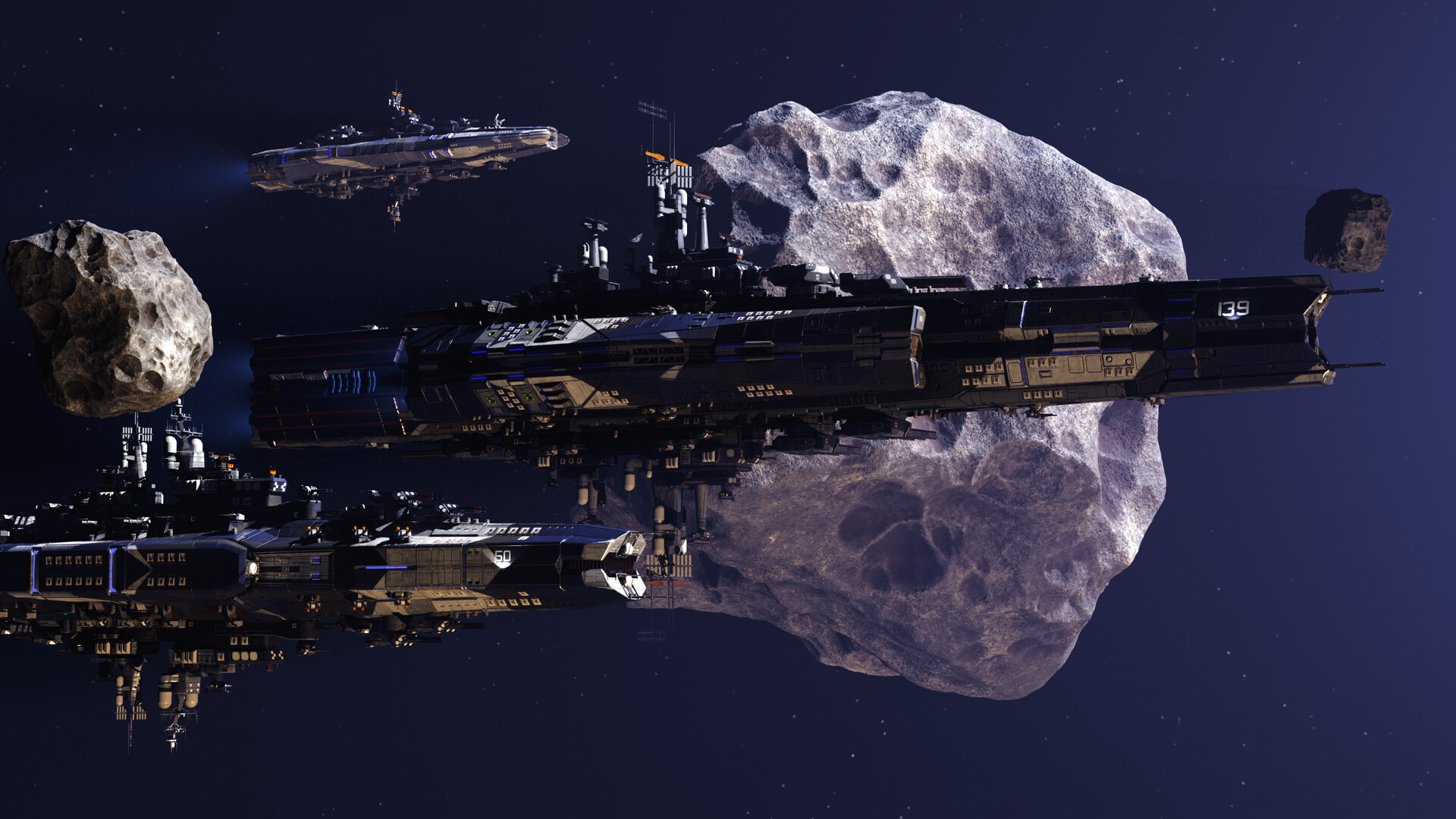
Salem, St. Helens (CL-50), and a Summers-class Destroyer pass close to an asteroid but maintain formation.

Salem and St. Helens are joined by St. Helens' sister, Tacoma (CL-51.)

Tacoma (CL-51) accelerates to exit the formation.

Salem and St. Helens pass into the shadow of a large asteroid.

A discarded shot meant to emulate pictures of cruisers in line ahead formation. It was tough to include all ships without losing them in the glare of the other's engines, or losing too much detail due to being too distant from the camera.

The original iteration of the first image. I wanted to retain the feeling of mystery caused by the background-most asteroid being lost in the fog, but I couldn't figure out how to keep it without losing the detail on the ships.

A size comparison between the Salem-class, Tacoma-class, and the preceeding St. Helens-class.

While prepping and modernizing the St. Helens model, I decided to spin off the Tacoma as a subclass, referencing the St. Louis variant of the Brooklyn-class light cruisers of WWII.

Size comparison of a large cruiser (CB), heavy cruiser (CA), light cruiser (CL), and a destroyer (DD). Turrets omitted.

The Olympia didn't make it into the scene sadly. But she'll show up soon.

UV Mapping for the Salem. The ships' designs allow me to cheat by mirroring along the x and z axes to save UV space. In the end however, the UV was repacked into a 2x2 multi-tile grid so I could pack in more detail.

PaInting the Tacoma in Substance Painter.

Previous iterations of the light setup.

Previous iterations of the light setup.