The Super-V
The F-8 Vagabond, widely described as the ‘Bent-Winged Bastard’ by friend and foe alike—albeit for entirely different reasons—was a product of wartime politics and development. The earliest variants up to and including the F-8E had a variety of teething problems and maintainability issues that were rectified with the F-8F model.
However, even they found themselves outmatched by networked intelligence drone craft like the Stahl-191 ‘Butcher Bird’ and its loadout of an 88mm rapid-fire coilgun and high intensity pulse laser arrays alongside internal and external munitions or were supplanted by the new F-6N Hellraiser in vacuum.
While the Hellraiser could make short work of enemy craft in orbit and in deep space, the Navy still needed a superiority fighter to perform a variety of missions in atmosphere.
Unwilling to part with the Vagabond due to its sturdy airframe, generous bay space, and long range, and perhaps unable to due to political pressure and lobbying, a decision was made instead to expand upon the Vagabond instead of replacing it entirely.
The job was soon awarded to the Astrid-Maxon Aerospace Corporation, which had previously acquired Bright Aviation, the Vagabond’s original designer.
This resulted in the F-8U Privateer, unofficially called the Super-V or Vagabond II. While keeping the same general shape and form of its ancestor, the Privateer integrated the same level of protection that had previously been available on the F-8F as an applique, replaced the Vagabond’s six Browning Heavy Pulse Lasers with four M3 heavy particle cannons, and doubled the thrust produced by the twin fusion engines, all without sacrificing the Vagabond’s maneuverability. All the while integrating a new model GRAVES—General Radar Augmented Vision Enhancement System—to give its pilot an unparalleled view of the battlefield.
This produced a craft that could kill at range and up close in equal measure, take hits that would otherwise down other craft, and engage and disengage from any battle at will.
--
<< Yo, buddy. Still alive? >>
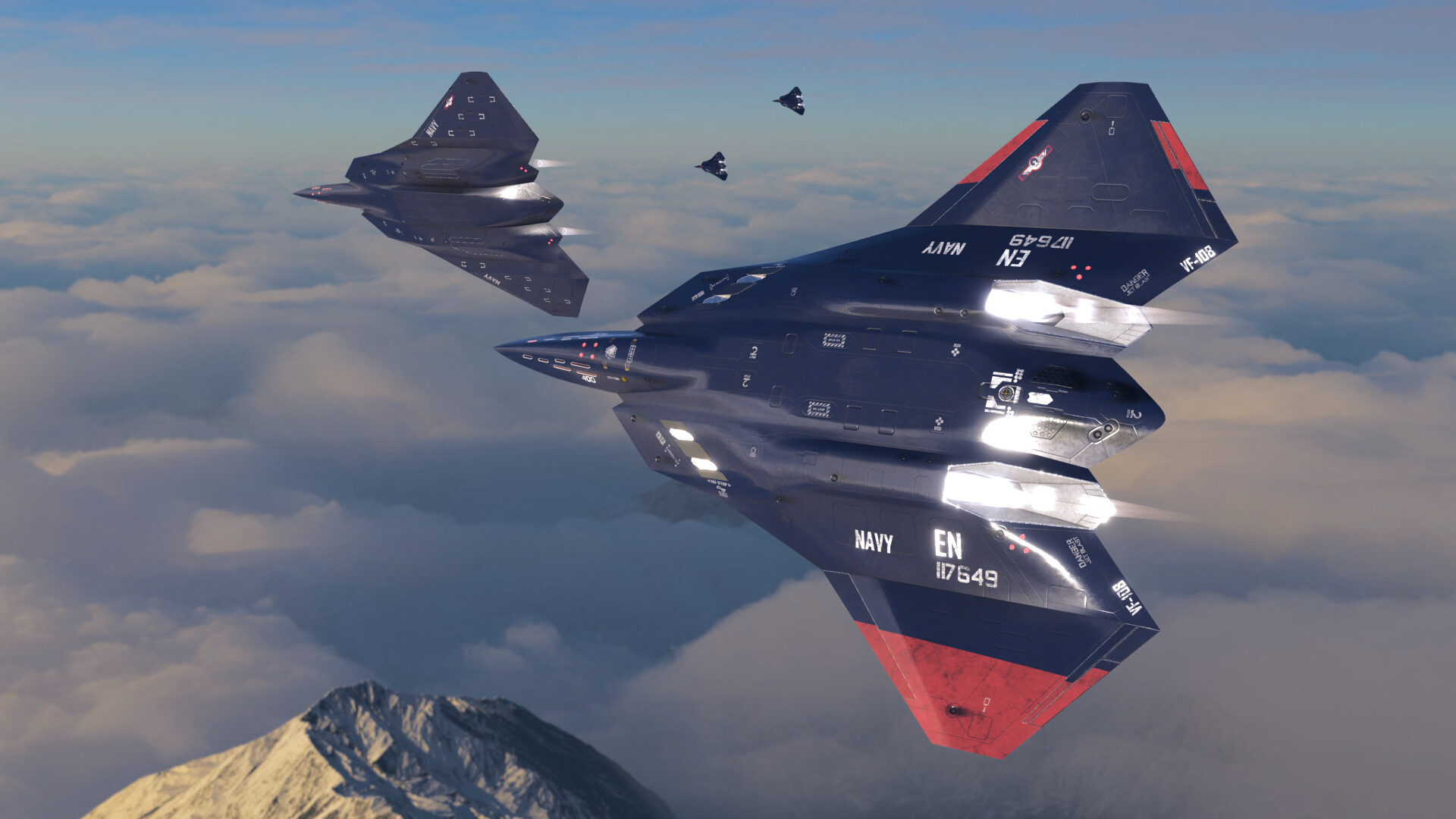
A four ship flight split into two elements. The classic 'finger-four' formation.

Another shot of the lead formation.

The story of 400's pilot is well-known: he was able to guide his plane through an atmospheric entry and land safely, all the while missing part of his left wing due to enemy fire.
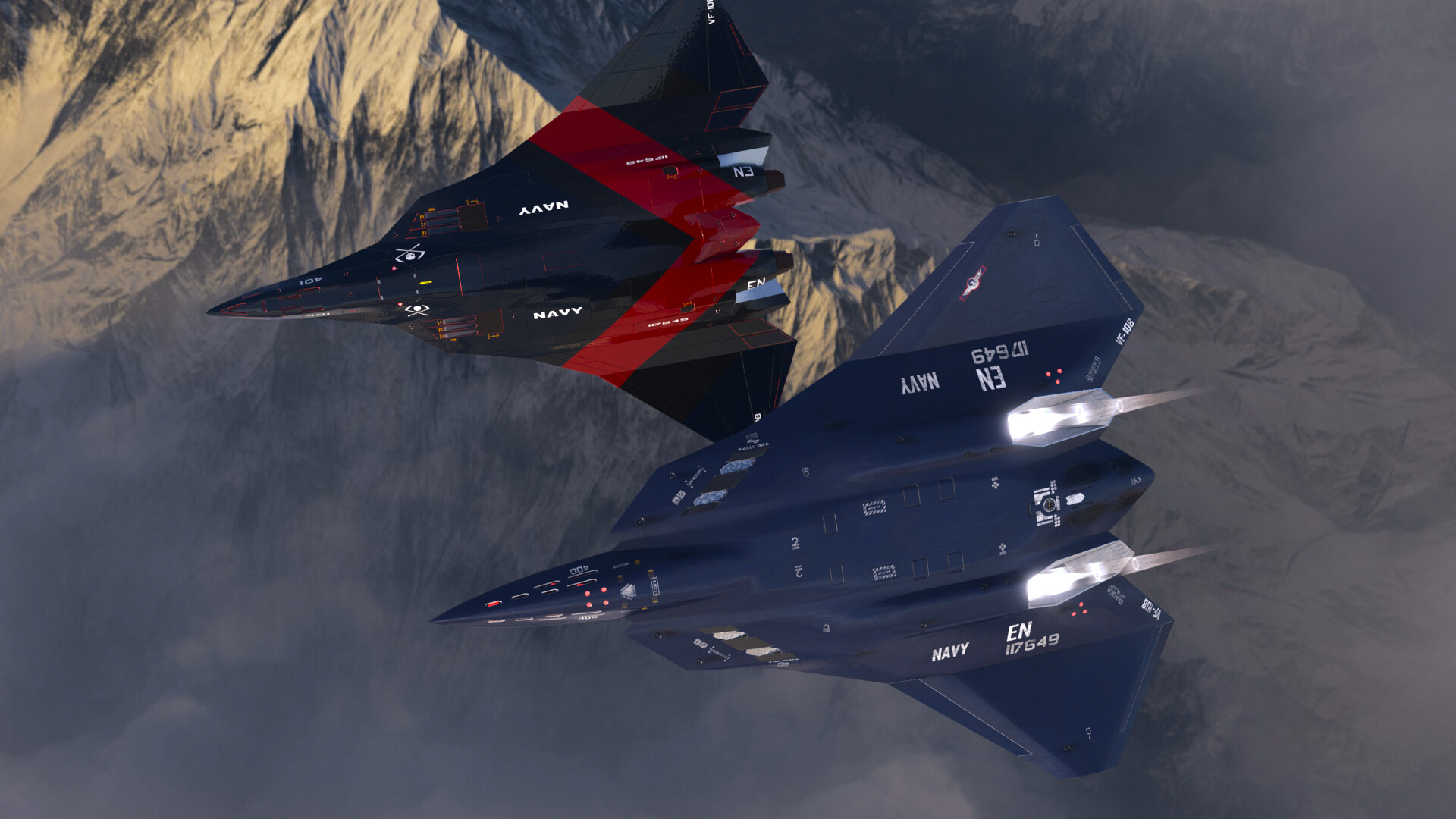
Comparing the F-8F (rear) and the F-8U (front)
